
By Nonte
Every year, research organisations invest millions building clinical data management infrastructure. Systems are selected, validated, and embedded. Teams are trained. And the data clean, structured, retrievable sits exactly where it should be.
Yet when a regulatory inspector asks why a key protocol decision was made, the answer is not in the system. When a licensing partner needs to understand the reasoning behind a study design, the audit trail shows what happened but not why. When a new scientist joins midway through a programme, the data is there but the context that gives it meaning is gone.
This is not a failure of clinical data management. It is doing its job perfectly. The problem is the missing integrity layer, the one most research teams do not have.
At Nonte.io, this is the gap we are building to close.
What the Industry Built and Why It Was Right
The challenge is most acute in translational science, the bridge between early research and clinical application, where a discovery made in a laboratory must become a treatment that works in a patient. It is a long journey, involving many teams, many decisions, and many handoffs. And at every handoff, context can be lost.

The compliance archive: everything filed, ordered, retrievable.
Clinical data management was built to solve a specific problem: capturing research data accurately, storing it securely, and making it retrievable on demand.
It answers the administrative questions that compliance demands:
- Was the data recorded correctly?
- Is the audit trail complete?
- Are the electronic signatures in place?
Frameworks like 21 CFR Part 11 and EU Annex 11 were built around exactly these questions and the industry has invested heavily to answer them reliably.
This is not a small thing. Administrative compliance is essential. Data quality and data assurance at the record level are the foundation of every credible research programme.
But administrative compliance is the floor, not the ceiling. It tells regulators that data was handled correctly. It does not tell them whether the science behind that data can be defended. And increasingly, that second question is the one that determines outcomes.
The Gap Nobody Has Named
There is a different set of questions that regulators, licensing partners, investors, and acquirers ask questions that go beyond administrative compliance into scientific defensibility:
Where did this data originate, and under exactly what conditions? How did this team get from the original hypothesis to this conclusion? Can any result in this programme be followed back to every person, decision, and moment that created it?
These are not administrative questions. They are scientific integrity questions. And a research team can be fully administratively compliant, clean data, complete audit trails, validated systems and still be unable to answer them. Because it was never designed to answer them.
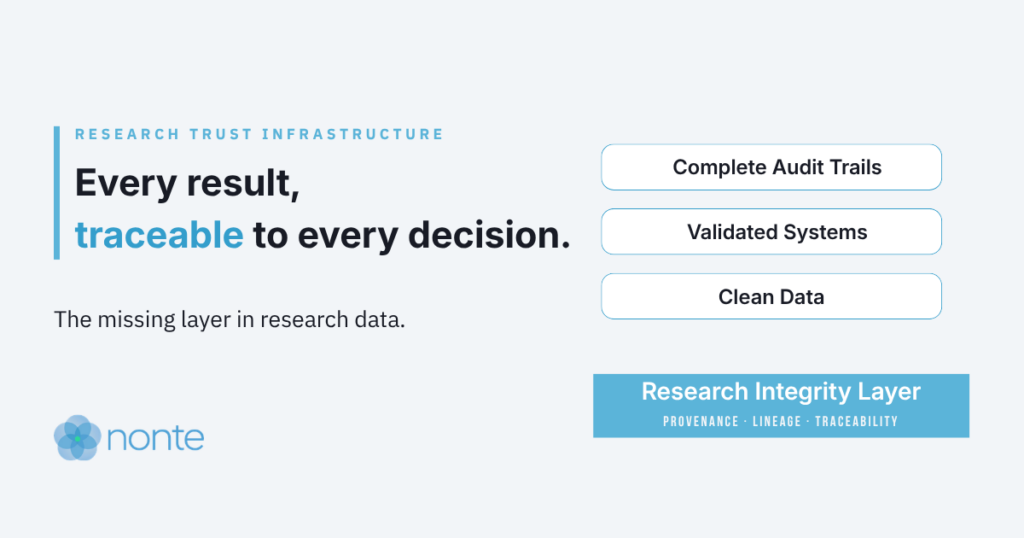
This is where research data provenance, research data lineage, and traceability come in. Together, they form the research integrity layer, the infrastructure that sits alongside clinical data management to deliver what compliance alone cannot: scientific defensibility.
Research data provenance is the origin story of your data. Who generated it, with what materials, under what conditions, at what point in the programme’s history. It transforms a data point into defensible evidence by establishing that the result can be trusted at its source.
Research data lineage is the reasoning trail of your programme. How did the team get from the first observation to this conclusion? What decisions shaped the direction of the research, what hypotheses were tested and abandoned, what protocol changes were made and why? It is the intellectual history that connects the beginning of a study to its end.
Traceability is the ability to follow any result backwards to every decision, every person, and every moment that contributed to it. It is what makes a programme fully defensible rather than just administratively compliant.
Together, these three form the research trust infrastructure that turns compliant data into science that can withstand scrutiny.
The Redo Tax
Click on the image to know more
The gap between administrative compliance and scientific defensibility is not just a regulatory risk. It is a budget problem.
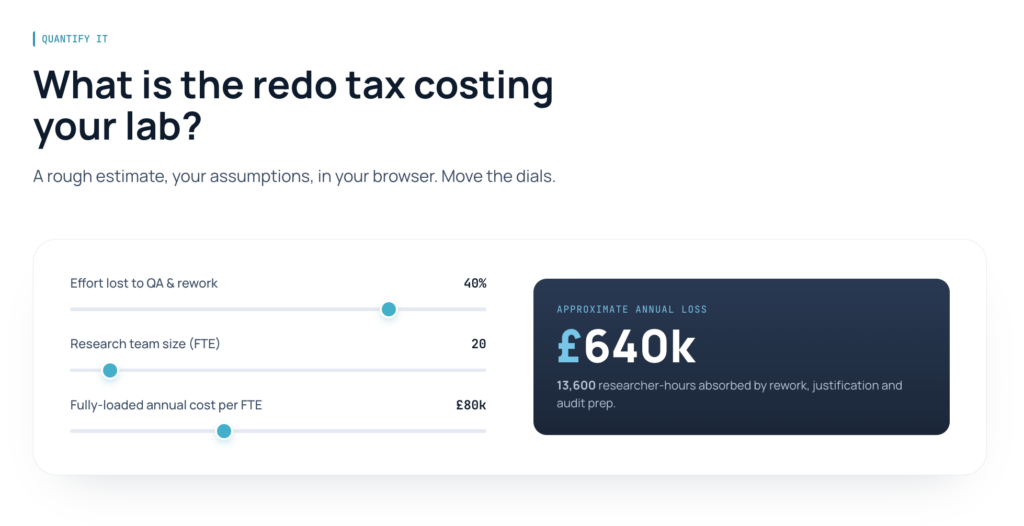
Industry estimates suggest approximately 40% of R&D budget goes toward work already done, studies repeated, experiments rerun, analyses redone not because the science failed, but because the research data provenance and lineage behind the original work could not be found. We call this the Redo Tax.
It is the cost of rebuilding context that was never preserved. Paid not once, but repeatedly at every regulatory inspection, every licensing discussion, every due diligence process where the integrity layer is missing.

The Redo Tax carries a cost that goes beyond budget. Repeated studies mean more animals used in research that has already been done. Delayed decisions mean patients waiting longer for treatments that could have reached them sooner. The cost of lost scientific context is not just financial, it is ethical.
The Research Integrity Layer, What It Is and What It Is Not
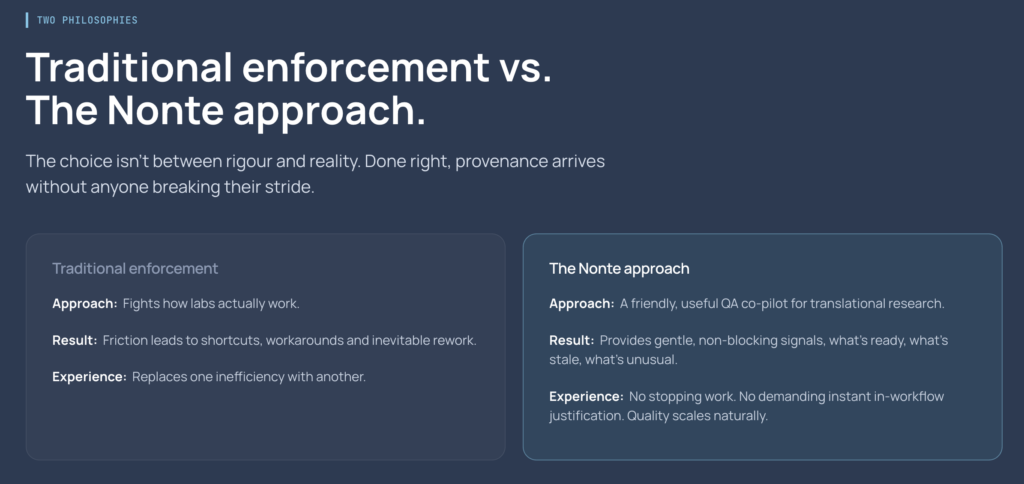
The research integrity layer does not replace clinical data management. It complements it.
Think of your research infrastructure as a building. Clinical data management are the walls: essential, structural, load-bearing. The research integrity layer is the foundation, the thing the walls rest on, the thing that determines whether the building can withstand external pressure.
You can have walls without a foundation. Many organisations do. The building looks solid in normal conditions. But when real pressure arrives, a rigorous regulatory inspection, a demanding licensing discussion, a thorough due diligence process the absence of a foundation becomes visible fast.
The research organisations that consistently survive regulatory scrutiny, close licensing deals efficiently, and command strong valuations at exit have both layers in place. Their clinical data management systems deliver data quality and administrative compliance. Their research integrity layer delivers scientific defensibility.
Where Nonte Fits
At Nonte, we are building research trust infrastructure, the integrity layer that sits alongside clinical data management to preserve research data provenance, research data lineage, and traceability behind every study and decision.
Click on the image to book a walkthrough
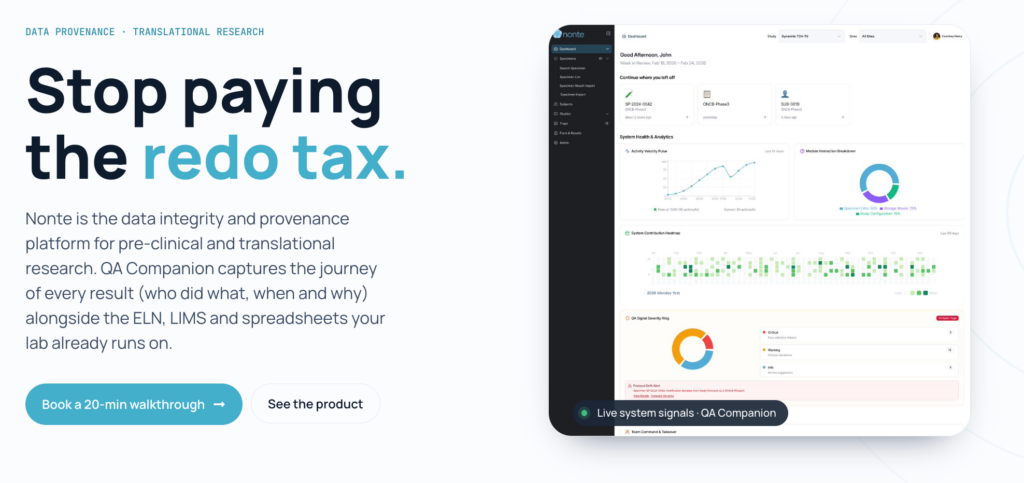
We are not a clinical data management system. We do not replace your ELN, your LIMS, or your CDM platform. We preserve the scientific context those systems were never designed to capture so that when a regulator, a partner, or an acquirer asks the hard questions, the answers are there.
Administrative compliance gets you to the table. Scientific defensibility keeps you there.
Your clinical data management system makes your data compliant. The research integrity layer makes your science defensible. You need both.
Nonte is built in partnership with Aston University and backed by Spark West Midlands. If this resonates with what you are seeing in your research organisation, we would love to hear from you.